 CIN:
We house a team of experts with proficiency in custom Web Application Development, Mobile Apps Development, AI Development, Software Development, Ecommerce
CIN: We house a team of experts with proficiency in custom Web Application Development, Mobile Apps Development, AI Development, Software Development, Ecommerce
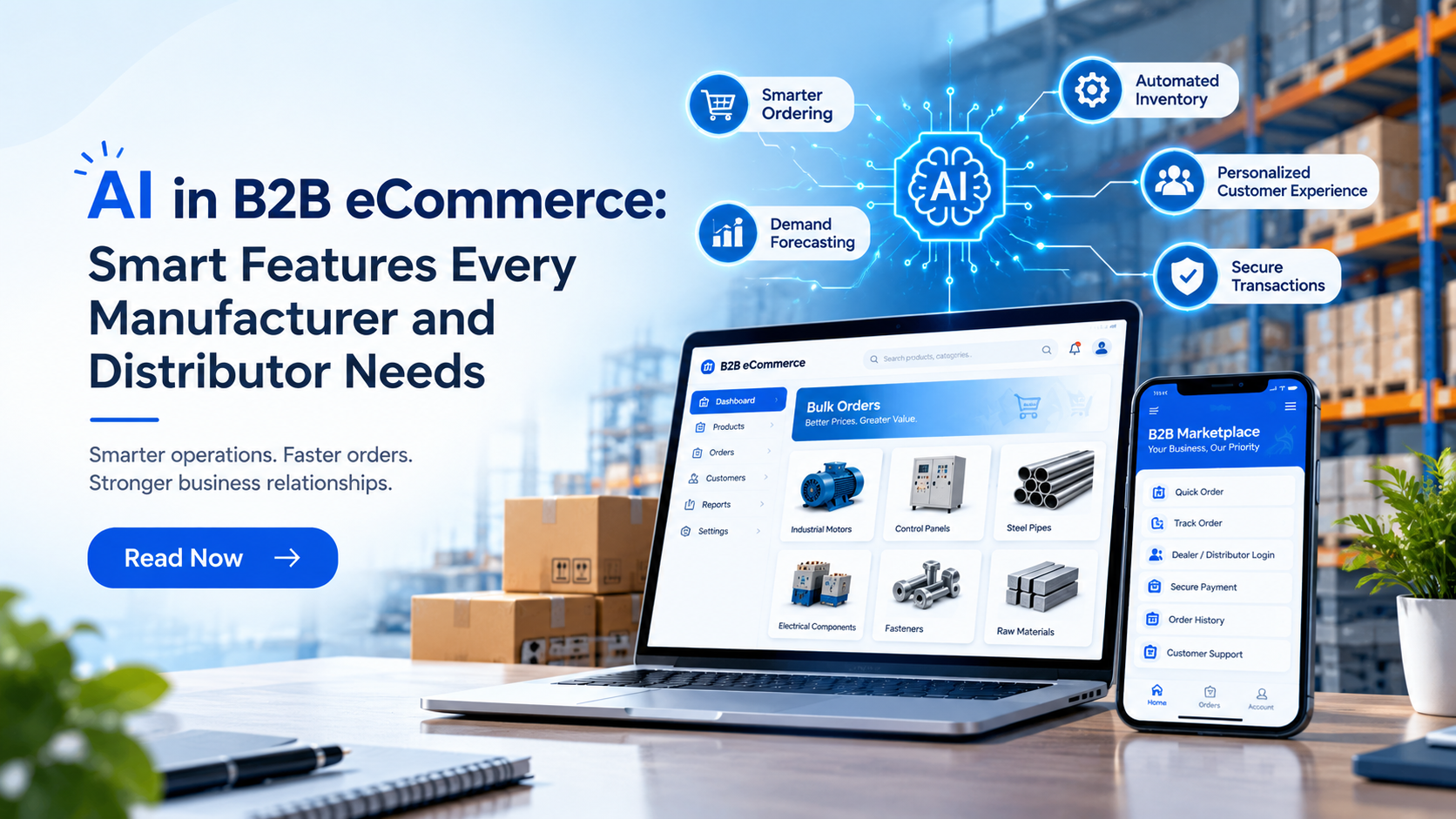
B2B eCommerce is transforming how manufacturers, wholesalers, and
distributors sell products and manage business relationships. Traditional
methods involving phone calls, emails, spreadsheets, and manual order
processing are gradually giving way to smarter digital platforms.
Artificial Intelligence (AI) is accelerating this transformation by
helping businesses automate repetitive tasks, predict customer demand,
personalize buying experiences, and make data-driven decisions. For
manufacturers and distributors handling large product catalogs, multiple
customers, and complex pricing structures, AI-powered eCommerce can improve
efficiency while creating new opportunities for growth.
Investing in the right technology is no longer just about selling
products online. It is about building a scalable digital platform that makes
purchasing easier for business customers and operations more efficient for
sellers.
Why AI Is Important for B2B
eCommerce
B2B transactions often involve bulk orders, negotiated prices, repeat
purchases, multiple approval levels, and long-term customer relationships.
Managing these processes manually can lead to delays, errors, and missed sales
opportunities.
AI helps address these challenges by analyzing business data,
identifying patterns, and automating routine activities. It can support faster
order processing, more accurate demand forecasting, and personalized product
recommendations.
For growing businesses, AI-powered B2B eCommerce creates a more
connected sales process, allowing teams to spend less time on administrative
work and more time building customer relationships.
7 Smart AI Features Every
Manufacturer and Distributor Needs
1. AI-Powered Product
Recommendations
Business buyers often purchase products based on previous orders,
industry requirements, and complementary items. AI can analyze purchasing
patterns to recommend relevant products to each customer.
For example, a distributor ordering industrial equipment may receive
recommendations for compatible accessories, replacement parts, or related
products.
These personalized suggestions can help businesses discover suitable
products faster, increase average order value, and improve the overall buying
experience.
Business benefit: More relevant product discovery and
additional cross-selling opportunities.
2. Intelligent Inventory
Management and Demand Forecasting
Maintaining the right inventory level is a major challenge for
manufacturers and distributors. Excess inventory increases storage costs, while
stock shortages can delay deliveries and damage customer relationships.
AI-powered inventory systems analyze historical sales, seasonal trends,
current stock levels, and other available business data to estimate future
demand.
These insights help businesses plan replenishment, identify fast-moving
products, and reduce the risk of overstocking or stockouts.
Business benefit: Better inventory planning, improved product
availability, and more efficient warehouse operations.
3. Personalized B2B Pricing
and Bulk Discounts
B2B businesses frequently offer different prices to dealers,
wholesalers, distributors, and long-term customers. Managing these pricing
structures manually can become complicated as the customer base grows.
AI can help analyze purchasing volume, order frequency, customer
segments, and historical buying behavior to support pricing decisions and
identify suitable discount opportunities.
The eCommerce platform can then apply predefined pricing rules,
customer-specific price lists, and approved discount structures.
AI should support pricing decisions within clear business rules,
ensuring that negotiated agreements and profit margins remain protected.
Business benefit: More efficient pricing management and
better-targeted sales opportunities.
4. AI Chatbots for 24/7
Customer Support
Manufacturers and distributors regularly receive questions about product
specifications, availability, pricing, delivery status, and order updates.
AI-powered chatbots can answer common questions, guide customers through
product catalogs, and help them find information without waiting for a sales
representative.
When integrated with the eCommerce platform and authorized business
systems, chatbots can also provide order-status information or direct complex
enquiries to the appropriate team.
Business benefit: Faster responses, reduced repetitive
workload, and improved customer satisfaction.
5. Automated Order
Processing and Reordering
Many B2B customers repeatedly order the same products. Manually
preparing purchase orders, checking quantities, and entering order details can
consume valuable time.
AI can help interpret purchase requests, recognize recurring buying
patterns, and suggest reorder quantities based on previous purchases and
available inventory.
Combined with automated workflows, these capabilities can reduce manual
data entry and help teams process orders more efficiently. Businesses should
still use validation rules and approval steps for high-value or unusual
transactions.
Business benefit: Faster order processing, fewer manual
errors, and a smoother purchasing journey.
6. Predictive Analytics for
Sales Growth
AI-powered analytics help businesses understand what is happening across
their sales operations and identify potential opportunities.
By analyzing customer activity, sales history, product performance, and
order frequency, these tools can highlight customers who may need follow-ups,
products experiencing increased demand, or accounts whose purchasing activity
has declined.
Sales teams can use these insights to prioritize leads, plan targeted campaigns,
and strengthen customer relationships.
Business benefit: More informed decisions, improved sales
planning, and proactive customer engagement.
7. AI-Driven Search and
Product Discovery
B2B catalogs may contain thousands of products with technical specifications,
model numbers, variations, and industry-specific terminology. Traditional
search functions may struggle when customers use incomplete or alternative
product descriptions.
AI-powered search can interpret customer intent, recognize related terms,
and improve product discovery. Depending on implementation, it can also support
natural-language queries and specification-based filtering.
For example, a buyer searching for a particular industrial component can
receive more relevant results even when the search phrase does not exactly
match the product title.
Business benefit: Faster product discovery and fewer barriers
during the buying process.
How to Implement AI in Your
B2B eCommerce Platform
Adopting AI does not mean rebuilding every business process at once.
Manufacturers and distributors can begin with practical improvements that
address their most pressing challenges.
Identify Your Business
Priorities
Determine whether your biggest problems involve manual ordering,
inventory planning, customer support, pricing, or sales follow-ups. Choose
features that address these specific needs.
Integrate Your Existing
Business Systems
Connect your eCommerce platform with relevant inventory management, ERP,
CRM, and accounting systems. Reliable, consistent data is essential for useful
AI recommendations and automation.
Choose Scalable Custom
Development
Every B2B business has different workflows, customer categories, pricing
policies, and approval requirements. Custom
Ecommerce Development Services can help create a platform tailored to
these operational needs, including dealer logins, bulk ordering,
customer-specific pricing, mobile access, and AI-powered capabilities.
Measure Performance and
Improve
Track metrics such as order processing time, repeat purchase rates,
stock availability, customer support response time, and conversion rates. Use
these results to refine your implementation and prioritize future improvements.
Choosing the Right
eCommerce Development Partner
Selecting the right technology partner is essential for building a
secure, scalable, and business-focused B2B platform.
An experienced Ecommerce
Development Company Kolkata can help manufacturers and distributors
plan their digital strategy, develop custom eCommerce functionality, integrate
business systems, and introduce AI features according to their requirements.
Look for a development partner that understands B2B workflows, supports
mobile-friendly experiences, prioritizes data security, and can scale the
platform as your business grows.
Rather than adopting AI simply because it is trending, focus on
solutions that deliver measurable operational and commercial value.
Conclusion
AI is reshaping B2B eCommerce by making product discovery smarter, order
management faster, inventory planning more informed, and customer experiences
more personalized. For manufacturers and distributors, these capabilities can
reduce operational friction and support sustainable business growth.
The best approach is to start with the features that solve your most
important challenges, connect them with reliable business data, and expand
gradually as results become measurable.
With the right strategy and technology partner, your B2B eCommerce
platform can become more than an online catalog. It can become an intelligent
digital sales channel that supports stronger customer relationships and
long-term growth.
Ready to build a smarter B2B eCommerce platform? Shanvia
Tech Solutions can help your business explore custom eCommerce development,
mobile applications, and AI-powered digital solutions tailored to your needs.
Visit Shanvia Tech to learn more.